


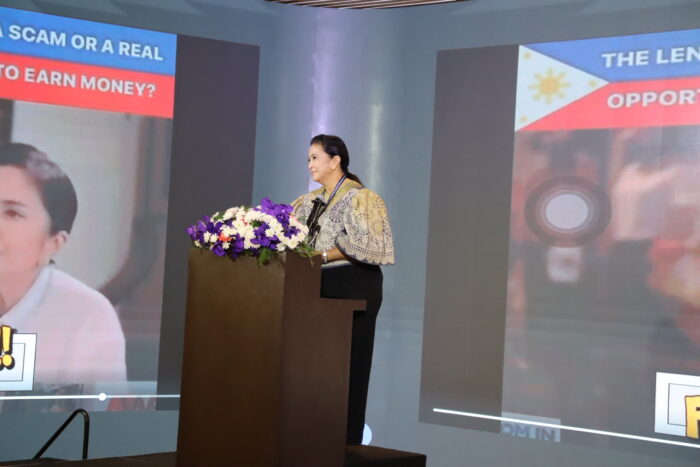
“The genie is out of the bottle. AI is here to stay – for better or for worse… It has woven itself into the very fabric of economies, politics, and daily life,” said Leni Robredo, former Vice President of the Philippines and current Mayor of Naga City, as she delivered the keynote address at the Council of Asian Liberals and Democrats (CALD) 15th General Assembly.
Supported by the Friedrich Naumann Foundation, the General Assembly convened on 30 October 2025 in Bangkok, Thailand, drawing together delegates from CALD member parties across Asia, along with regional partners and European counterparts.
This year’s theme, “AI, Inequality and Democracy: The Challenge for Liberals and Democrats,” framed discussions on how liberal and democratic actors can craft effective strategies to curb AI-driven inequality and reinforce democratic institutions amid widening gaps in income, wealth, and political power.
Among the attendees were party leaders, elected parliamentarians, and women and youth representatives from CALD’s member organizations.
In his opening remarks, Abhisit Vejjajiva, leader of Thailand’s Democrat Party and former Prime Minister, underscored the importance of learning from history. He noted that throughout the agricultural and industrial revolutions, societies succeeded not because change was easy, but because people had the will to adapt and redesign the way work and governance were done.
“We can’t wish artificial intelligence away – it will only develop at an incredible pace. It’s up to us to design a framework of government to make sure artificial intelligence serves us,” Vejjajiva said.
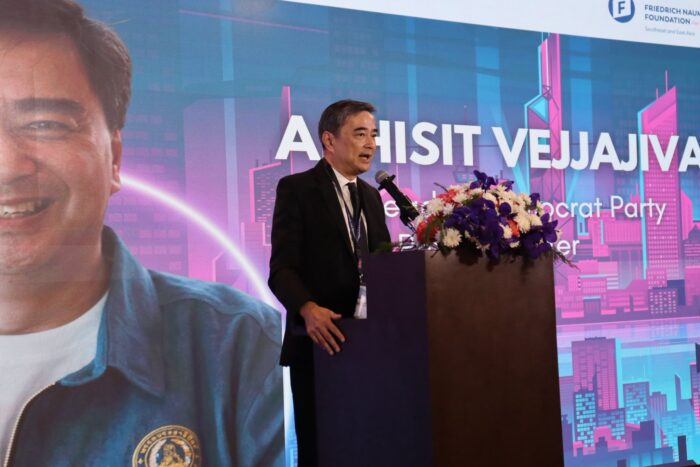
He warned of the real risks ahead: disruption, job displacement, disinformation, the erosion of trust, and a culture that values only results, not the process. This danger, he stressed, becomes critical in politics. “Politics is what democracy is about. It is a process to get results, and if AI creates a culture where people are only interested in results, not thinking about the means and the process, democracy will truly be at risk.”
Conference sessions explored how AI intersects with economic inequality and democratic decline, and what initiatives and policy directions liberals and democrats must pursue to not only survive but thrive in the age of AI.
Robredo, in her keynote address, shared firsthand how AI has been used to discredit her through deepfakes and online scams. “In the wrong hands, AI becomes a weapon for manipulation and disruption,” she said. She further warned that around the world, governments are already using AI in ways that undermine rights and weaken democratic accountability—such as facial recognition and mobile data systems used to track, monitor, and detain minority communities and dissenting voices, eroding privacy, freedom of movement, and civic space.
Yet Robredo also highlighted AI’s promise. With the right safeguards, AI can improve governance, enhance public service delivery, and strengthen public participation through data-driven, evidence-based policymaking. She shared her vision for Naga City as an “open and digital city,” emphasizing the development of the “MyNaga” app as an example of how AI-driven tools can help local governments adapt to evolving needs in urban planning, traffic management, and disaster response.
A common call across the conference was the need to deepen international cooperation. “As liberals and democrats, our basic tenet is to have faith in people… and trust them to come up with systems of governance to make sure AI really works for us,” Vejjajiva said. Robredo echoed this, urging the creation of guardrails for responsible AI use: “We must insist that any new technology support human rights and development. The people must remain at the center of it… and it must serve humanity’s highest aspirations – towards human dignity and the strengthening of our democracy.”
The four-day gathering also saw the culmination of the CALD Asian Women Education (AWE) Mentorship Program, a three-month initiative designed to help young women strengthen their public leadership and democratic resilience across Asia, as well as the Executive Committee Meeting, where leaders of CALD member-parties set the next steps for the regional organization.
Categorised in: News, News Article
This post was written by CALD
 Unit 409, 4/F La Fuerza Plaza 2, 2241 Don Chino Roces Ave. corner Sabio St., 1231 Makati City, Philippines
 +632 8819 60 71
 info@cald.org