


“The case of the Philippines and Ukraine demonstrate the importance of international mechanisms that will go after the enemies of human rights. Without a doubt, Duterte and Putin belong to these class of international criminals who should all be brought to justice,” said Leila de Lima during the conference held on 17 November 2025 at Hotel Benilde Maison De La Salle.
Jointly organized by the Council of Asian Liberals and Democrats (CALD) and the De La Salle–College of Saint Benilde School of Diplomacy and Governance, the conference titled “Duterte’s Crimes Against Humanity and Putin’s War Crimes: What the Philippines and Ukraine Can Learn from Each Other?” drew powerful parallels between the two nations’ struggles against state violence and authoritarianism, with speakers emphasizing that the defense of human dignity is a universal obligation—one that extends far beyond national borders.
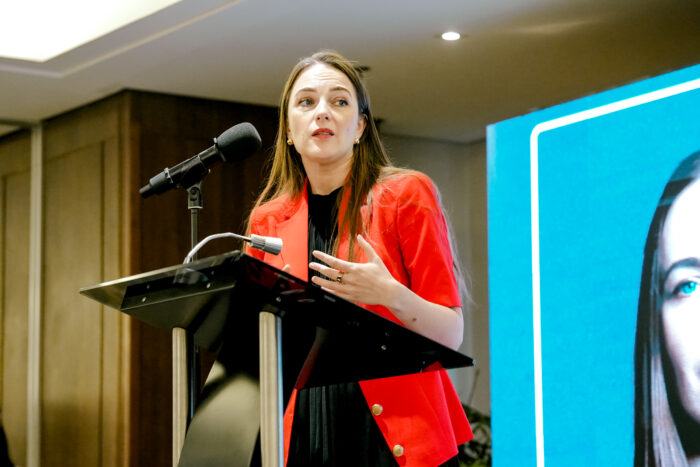
The gathering coincided with the visit of Atty. Oleksandra Matviichuk, 2022 Nobel Peace Prize Laureate and head of Ukraine’s Centre for Civil Liberties. She was joined by fellow keynote speakers Hon. Leila de Lima, Member of the House of Representatives (ML Partylist) and former Philippine senator, and Fr. Flaviano Antonio “Flavie” Villanueva, 2025 Ramon Magsaysay Award Laureate from the AJ Kalinga Foundation, Inc. The three delivered compelling reflections, personal testimonies, and urgent appeals rooted in their countries’ respective experiences with impunity and violence.
They were joined by voices from the diplomatic, academic, and human rights communities. Dr. Gary Dionisio, Dean of the School of Diplomacy and Governance; Dr. Almut Besold, Country Director of the Friedrich Naumann Foundation Philippine Office; Oleksandr Lysak, First Secretary of the Embassy of Ukraine; Ms. Joyce Crisanto, Director of the Human Rights Policy Center at the Commission on Human Rights; Mr.frRitz Lee Santos III, Section Director of Amnesty International Philippines; and Atty. Raeyan Reposar of the School of Diplomacy and Governance each offered reflections on confronting impunity, curbing the abuse of state power, and drawing lessons from shared experiences of resistance.
(photo credits to Friedrich Naumann Foundation for Freedom Southeast and East Asia)
Parallel Histories of Impunity
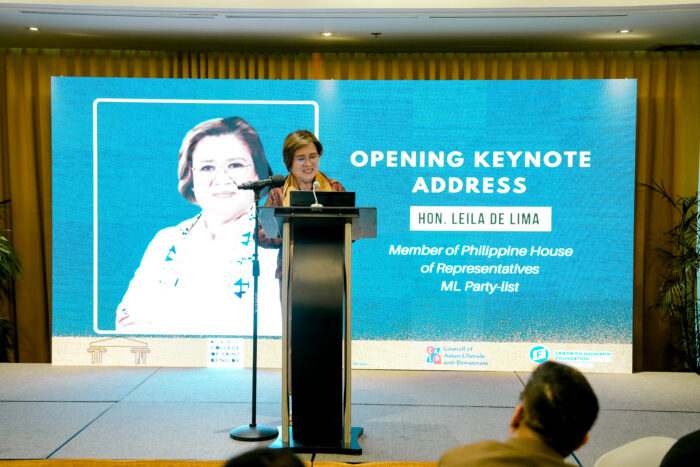
De Lima delivered an intense reflection of the Philippines’ history of state violence. She narrated that what the world witnessed as former President Rodrigo Duterte’s drug war was “merely the final, most explosive eruption” of a system of extrajudicial killings perfected in Davao City long before 2016. By mid-2016, she said, the country was seeing an average of 30 killings a day—“a national emergency created by the state itself.”
Her early attempt to launch a Senate inquiry into the killings was met with swift retaliation. She recalled that she was removed as committee chair, vilified in public, and targeted with fabricated allegations. Duterte’s victims, she said, “remain undiscovered,” and without truth there can be “no peace for the victims and no reconciliation for the nation.”
De Lima expressed that, “Our struggle is not isolated. Ukraine faces its own monstruous adversary in Vladimir Putin. The Ukrainian people confronted an external aggressor who wages war against civilians, destroys cities, and breaks families apart. Both our nations carry the weight of unburied dead, both confront leaders who believe they could shape society with fear. Both confront the lone shadow of impunity.”
Ukrainian human rights defender Oleksandra Matviichuk described a different but equally devastating pattern of unpunished atrocities, tracing Russia’s violence from Chechnya to Georgia, Mali, Libya, and now her own country. “Unpunished evil grows,” she warned. “All this hell we experience in Ukraine is a result of total impunity, which Russia has enjoyed for decades.”
She called the current invasion not just a conflict between two states but “a war between two systems—authoritarianism and democracy.” Russia’s goal, she believes, is to prove that democracy and human rights are “fake values” that cannot protect people. An authoritarian bloc, she noted, is emerging: Russia receives drones from Iran, shells and troops from North Korea, and technological support from China.
“They see people as an object to be controlled.” To Russia, “Ukraine is just a tool to break the existing world order” and impose their own vision.
(photo credits to Friedrich Naumann Foundation for Freedom Southeast and East Asia)
Both De Lima and Matviichuk urged the international community to adopt stronger mechanisms to pursue justice against leaders who commit mass violence. De Lima renewed her call for a Philippine Truth Commission on the drug war to identify victims, establish accurate death tolls, and determine reparations. “Only a national reckoning,” she said, “can explain why an entire country permitted such violence.”
Matviichuk, likewise, stressed the need for global action, saying Ukraine is fighting not only for its own survival but for the UN Charter and “the international principle of inviolability of borders.” If Putin succeeds, she warned, other authoritarian leaders will be encouraged to do the same.
“We are working to provide the people affected by this war, regardless of who they are, regardless of their social position, a chance to achieve justice.”
Fr. Flavie Villanueva, who works with families of extrajudicial killing victims through Program Paghilom, described how the drug war erupted like “mass hypnosis”—a collective belief that violence could purify society. He spoke of visiting homes where widows kept their heads low and voices quiet, too afraid to grieve openly.
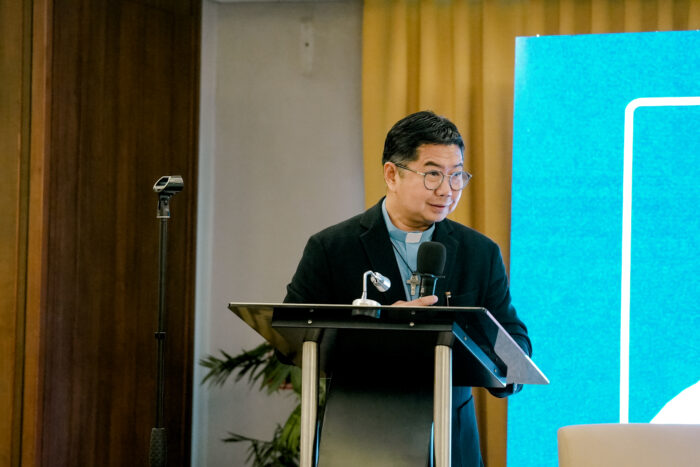
“Injustice may take different shapes across nations,” he said, “but the human cost is always the same.” Program Paghilom has now worked with at least 336 widows, helping them rebuild their lives while making sure victims “do not disappear.” Silence, he said, “would be betrayal.”
Matviichuk, delivered a similarly brutal portrait of life under occupation: disappearances, torture, rape, denial of identity, mass graves, and the forcible adoption of children. “Occupation does not decrease suffering,” she warned. “It only makes suffering invisible.”
(photo credits to Friedrich Naumann Foundation for Freedom Southeast and East Asia)
Despite the gloomy narratives and sorrowful accounts, the speakers stressed that people—not institutions—remain the strongest force against oppression. “Ordinary people can do extraordinary things,” Matviichuk said, insisting that civil resistance is rooted in dignity and that dignity is action.
“The basis for the Ukrainian people’s resistance is dignity and dignity is action. We are not hostages to the circumstances, we are participants in this historical process. Dignity gives us the strength to fight even in unbearable conditions. And I know that people in the Philippines and the rest of the world are also fighting for freedom and human dignity,” Matviichuk added.
Villanueva echoed her sentiment, “The standing up for the vulnerable is the quiet defiance – a refusal to let victims disappear…We continue the work not because we are heroes, but because silence would be betrayal.”
Categorised in: News, News Article
This post was written by CALD
 Unit 409, 4/F La Fuerza Plaza 2, 2241 Don Chino Roces Ave. corner Sabio St., 1231 Makati City, Philippines
 +632 8819 60 71
 info@cald.org