



The session on peacebuilding at the Council of Asian Liberals and Democrats (CALD) 15th General Assembly last October 30, 2025 highlighted a critical reminder for democrats navigating the age of artificial intelligence: without peace and political stability, societies cannot fully confront AI-driven inequality nor defend democratic institutions.
Moderating the first panel, “Principles and Mechanisms of Peacebuilding”, Moritz Kleine-Brockhoff, Regional Director of the Friedrich Naumann Foundation for Southeast and East Asia, noted that “Without peace, talking about AI is a luxury,” he said, pointing to ongoing crises in Myanmar, the South China Sea, and other parts of the region.
In her presentation, Dr. Melanie Reyes, Executive Director of the Women and Gender Institute Faculty, Department of International Studies at Miriam College, emphasized that peace is defined not merely by the absence of violence, but by the existence of justice, opportunity, and resilience for everyone. She stressed the importance of local ownership, inclusion of marginalized groups, and long-term commitments to institutional trust- elements necessary to ensure the sustainability of effective peacebuilding.
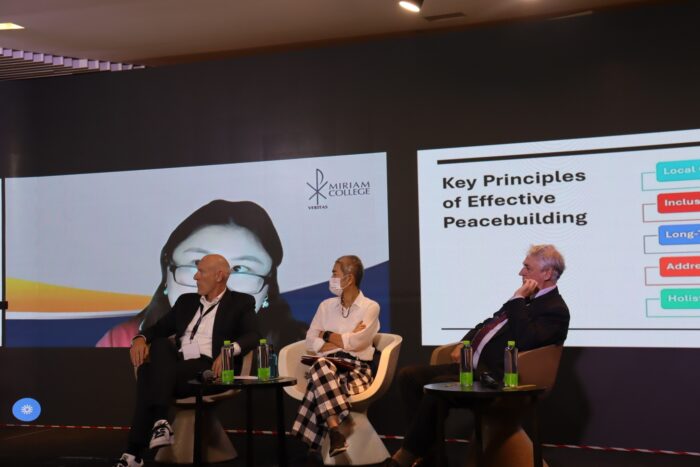
Founding Member of the SEAHRN Dr. Sriprapha Petcharamesree, connected peacebuilding to rights protection in the digital age. She illustrated why peace remains difficult in Thailand’s Deep South, citing entrenched military interests, identity suppression, and structural obstacles. “Since 2004, the army has been there with a lot of money. Keeping violence is one of the ways for them to be there,” she said. She added that Malay youth wearing traditional attire have faced charges possibly under Article 116, showing how marginalized communities can become targets of discrimination, surveillance, and profiling, including through emerging technologies.
From a global perspective, Liberal International Vice President Phillip Bennion said the Northern Ireland peace process worked largely because it allowed people to “agree to disagree,” creating space for two identities to live side by side without violence. He explained that the roots of the conflict stretch back centuries, and understanding that history is essential to understanding why peace was so difficult to achieve. Bennion pointed out how actions like gerrymandering, internment and majoritarian politics deepened resentment and showed why any peace effort had to be genuinely inclusive. He noted that the Good Friday Agreement finally brought stability by introducing power-sharing, ensuring fair political representation and accepting that people could hold either or both national identities. Civil society groups also played a big part, helping rebuild trust through work that involved both communities. Bennion added that although some divisions remain, younger generations are mixing more freely, giving reason to hope that the peace will continue to strengthen.
The second part of the session “Peacebuilding and its Relevance to Current Conflicts” focused on peacebuilding mechanisms and their relevance to current conflicts. Introducing the panel, Vanessa Steinmetz, Project Director for the Friedrich Naumann Foundation in Thailand and Vietnam, stressed that peace requires “dialogue, participation, trust, and inclusivity,” principles that are as relevant within communities as between nations. She pointed to ongoing tensions in Thailand’s Deep South and along the Thai–Cambodian border, noting how fragile peace can be when historical and cultural grievances run deep.
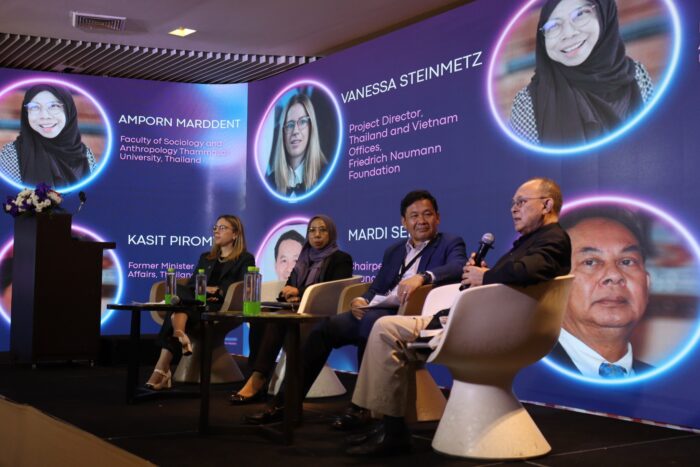
The panel featured Dr. Amporn Marddent of Thammasat University, Senator Mardi Seng of Cambodia, and former Thai Foreign Minister Kasit Piromya.
Dr. Amporn focused on protecting vulnerable populations in borderland conflict zones, highlighting gendered experiences in Southern Thailand and along the Myanmar border. Drawing from ethnographic work, she emphasized understanding women not only as victims but as active survivors navigating danger and seeking solutions.
Kasit Piromya underscored the global dimension of peace-building, sharing his recent role as Special Advisor to the mayors of Hiroshima and Nagasaki on nuclear abolition. Reflecting on meetings with atomic bomb survivors, he described the enduring human cost of conflict and urged international citizen networks to pressure world powers to prioritize peace, harmony, and common prosperity.
Speaking next, Senator Mardi Seng discussed the renewed tensions between Cambodia and Thailand. He noted that the two countries recently reached an expanded ceasefire agreement formalized on October 26 at the ASEAN Summit which includes the release of detained soldiers, removal of heavy weapons along the 800-kilometer disputed border, and deployment of an ASEAN observer team. Nationalism, he said, is often used by political elites to distract from internal crises.
He noted that the episode served as a stress test for ASEAN’s conflict-management capacity, revealing both its stabilizing potential and its limitations when faced with strong domestic rivalries and external power pressure.
Across the special session, speakers emphasized that peace, inclusion, and human rights are essential foundations for resilient democracies. The discussion reinforced the central theme of the General Assembly: liberals and democrats must build stable, rights-based societies capable of resolving conflict peacefully and safeguarding the dignity of all people.
Categorised in: News, News Article
This post was written by CALD
 Unit 409, 4/F La Fuerza Plaza 2, 2241 Don Chino Roces Ave. corner Sabio St., 1231 Makati City, Philippines
 +632 8819 60 71
 info@cald.org