


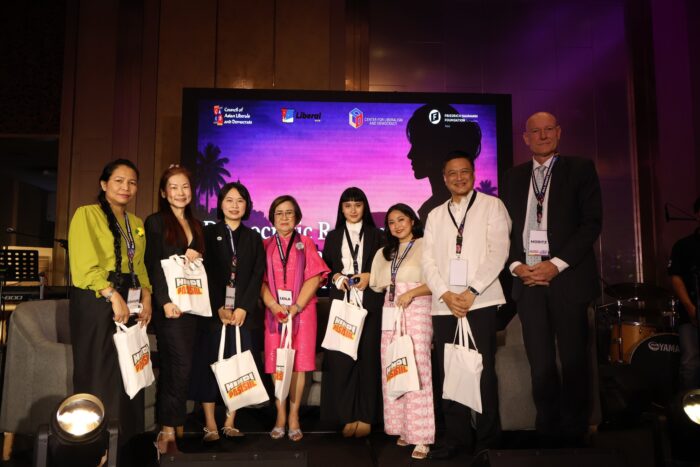
“Violence against women in politics is also a method…a way of shaping who gets to speak, who gets to lead, and ultimately, who gets to decide the direction of the nation.” – Rep. Leila De Lima, Philippines
The powerful opening panel of the “All About Democracy” series of events organized by the Council of Asian Liberals and Democrats (CALD) emphasized that violence against women in politics, whether physical, digital, psychological, or reputational, is not merely a gender issue, but a democratic issue. Held on 26 March 2026 at Dusit Thani Manila, the panel underscored that when women are attacked for leading, democracy itself is attacked for existing.
The first evening was attended by CALD member party representatives across Southeast and East Asia, alongside the sectoral and community networks of the Liberal Party (LP) of the Philippines, also in celebration of the Party’s 80th founding anniversary. But the night went beyond commemoration and reflected the Party’s enduring legacy of principled leadership. “Let (this gathering in Manila) be a space where we reaffirm our commitment to democratic ideals, but to democratic action”, said Lorenzo “Erin” Tanada, LP’s president. “…let us send a clear and unmistakable message: that we will not only stand for democracy – we will defend it, expand it, and make it deliver for every citizen we serve.”
Drawing from eight decades of steadfast commitment to democracy and liberal values, the occasion was indeed marked not only by reflection but by action — placing a spotlight on one of the most pressing and fast-growing threat to democratic resilience in the region: Violence Against Women in Politics (VAWP). “It is widespread, it is shocking and it must stop… and a good start is to talk about it more”, said Moritz Kleine-Brockhoff, regional director of Friedrich Naumann Foundation (FNF) Asia, in his opening remarks.
The panel featured introductions from three women leaders, each offering deeply personal and political insights into how gender-based attacks continue to shape democratic spaces across the region. Moderated by journalist Mara Cepeda, the panel brought together Philippine Legislator Leila de Lima, Taiwan’s Youth Leader Michelle Wu, and Thai Political Candidate and Cultural Figure V Srivarathanabul, whose opening remarks set a candid and urgent tone for the discussion.
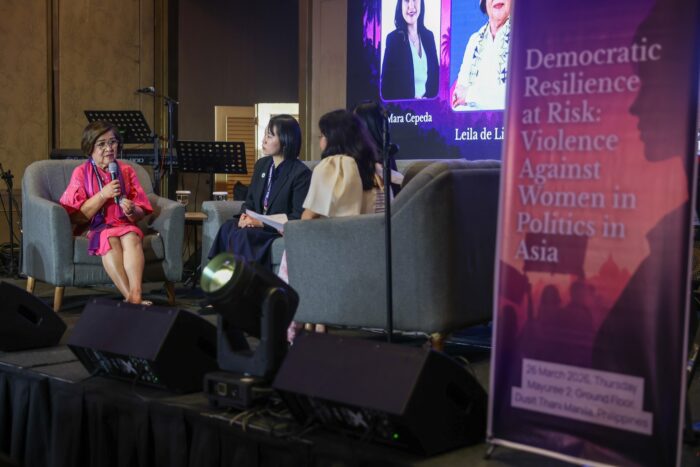
“Every time a woman shines, dirt will be thrown at you… just to diminish your character and your reputation.” This is how De Lima described VAWP as a tool to deliberately control political participation and shape power against women leaders. “The goal is isolation”, she added, drawing from her own experience where gendered attacks didn’t stop with slut shaming but also managed to create a system of disinformation designed to make leadership and politics feel isolating, pushing women out of public life.
The conversation went on with Michelle Wu, offering a data-driven perspective showing representation is not enough. Echoing De Lima, she noted that even in countries like the Philippines and Taiwan where women are visibly present in politics, female leaders are not shielded from gender-based scrutiny deeply entrenched from patriarchal norms. In Taiwan, she observed that women make up over 41% of legislators, largely due to quota systems. Yet, she stressed that women candidates are still criticized based on personal lives and family roles rather than competency. “Even if women have same or close representation in Taiwan, women need to commit more in politics to show that we do really have the strength and capability that we can lead just as men do…all of them don’t have children – they sacrificed their lives to prove that women have the capability in politics so that we, the younger generation have more space to create”. Wu also pointed to societal expectations around caregiving as a structural barrier, forcing women to navigate a persistent dilemma between career and family which male politicians rarely face. “Whether we are married, whether we have children… becomes something that is evaluated and even used to devalue women in politics”, she added. Despite these challenges, she highlighted emerging policy solutions, including more flexible parental leave systems aimed at redistributing caregiving responsibilities.
The discussion continued with Srivarathanabul bringing a fresh and candid voice as she reflected on her unconventional path into politics and the personal toll of gendered scrutiny saying, “I never really thought of myself as a female… but the world doesn’t let that slide. The world sees my gender before who I am.” She recounted being publicly judged based on appearance rather than qualifications, including being ranked alongside other candidates pitted against each other based on their looks and nothing else. While some criticism appeared framed as “professional standards,” she challenged the underlying bias as to who constructed the standards and definitions matter, in this case, “being professional”. Srivarathanabul argued that true inclusion requires redefining political norms, not simply allowing women to adapt to them – “It’s not about a woman making herself strong enough to jump over a wall – it’s about breaking the wall.”
Despite their different contexts, the three panelists echoed a shared lived reality: women in politics continue to face systemic barriers rooted in cultural norms, institutional gaps, political strategy, and evolving digital threats. Moving beyond numerical representation in politics is surpassing barriers constructed to limit one’s perspective and leadership. When asked if they feel protected enough by the political parties that they are part of, it is unanimous; Legislator Leila De Lima from the LP, Deputy Director Michelle Wu from the Democratic Progressive Party of Taiwan, and V Srivarathanabul from the Democrat Party of Thailand, stated that the spaces where they are right now in their political career not only protects but supports their participation may it be through institutionalizing a policy, or through recognizing women based on their capacities, or embedding the culture in everyone involved in the system.
The floor was then opened for questions, reflections, and even constructive provocations from the audience before moving on to the closing remarks of the CALD Women’s Caucus Chairperson, Jaslyn Go, from the Singapore Democratic Party and a video showcasing LP through the years as introduced by CALD Secretary General, Francis Gerald “Blue” Abaya. It was shortly followed by a toast to democracy, opening the gala dinner and fellowship.
As the discussions unfolded, one message stood clear: the fight against VAWP is not just about protecting women – it is about protecting democracy itself, through passing legislations such as House Bill No. 8393 – The Prevention of Violence Against Women in Politics Act and letting go of the system that filters people out because “where women endures, democracy endures”.
The panel and gala dinner were held in partnership with the LP and Center for Liberalism and Democracy, with the support from FNF Asia.
Categorised in: News Article
This post was written by CALD
 Unit 409, 4/F La Fuerza Plaza 2, 2241 Don Chino Roces Ave. corner Sabio St., 1231 Makati City, Philippines
 +632 8819 60 71
 info@cald.org