


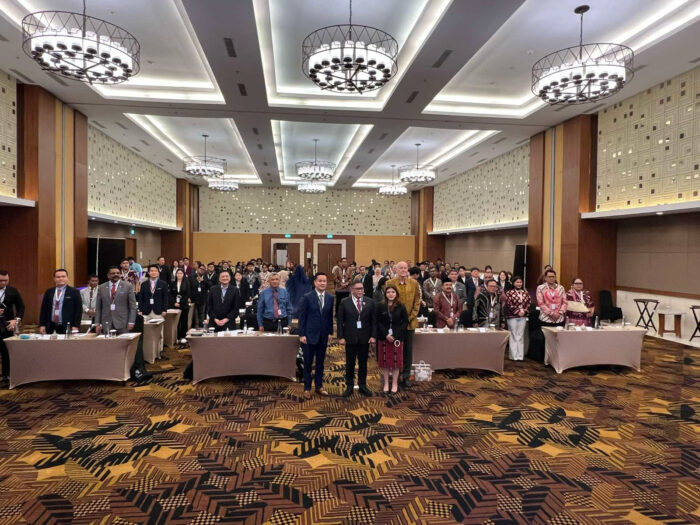
“Democracy is our enduring hope. Hope that ordinary people can govern themselves. Hope that differences can be resolved without violence. Hope that justice can stand above power, and hope that no citizen is too small to matter.”
With this call for renewed democratic commitment, Dr. Ir. Hasto Kristiyanto, M.M., Secretary General of the Indonesian Democratic Party of Struggle (PDI Perjuangan), opened the CALD Conference on Democratic Resilience in Southeast and East Asia on 4 September 2026 in Yogyakarta, Indonesia.
Around 120 participants gathered for the international conference to examine the growing challenges facing democracy across Asia and identify strategies for strengthening democratic resilience. Among them were 30 political leaders and officials from 12 Asian countries representing CALD member parties, partners, and observers.
The conference explored the pathways and mechanisms of democratic backsliding and examined how political parties, democratic institutions, civil society, and citizens can work together to withstand political pressures. A central theme was the relationship between party institutionalization and democratic resilience, particularly as political organizations confront declining democratic standards, personalistic politics, shrinking civic space, and increasingly difficult electoral environments.
In his keynote address, Hasto described democratic resilience as the capacity of democratic institutions, political parties, civil society, and citizens to withstand political shocks and pressures while preserving democratic values, accountability, the rule of law, and meaningful participation.
He warned that authoritarian populism increasingly exploits public frustration while weakening democratic institutions, freedoms, and norms. Drawing from PDI Perjuangan’s experience, he identified strategic leadership, ideology, and party institutionalization as important pillars of resilience, enabling political parties to maintain coherence, integrity, internal democracy, and continuity amid changing political conditions.
Hasto also called for stronger checks and balances, the supremacy of law, democratic and institutionalized political parties, critical thinking, an active civil society, and a democratic culture grounded in social justice.
Democratic Backsliding and Strategies for Resilience
The conference’s first session examined democratic backsliding in Indonesia, the Philippines, and Thailand, focusing on the institutional and political mechanisms through which democratic safeguards are being weakened.
Speakers highlighted the increasingly institutional and legalistic character of democratic erosion. Isra Sunthornvut, Member of Parliament representing the Democrat Party of Thailand, observed that “modern coups are institutional, leveraging legal and constitutional loopholes rather than tanks.” Abuse of process, weakened checks and balances, and the politicization of key institutions were also identified as mechanisms through which democratic systems can be weakened from within.
Weak party institutionalization can further increase these vulnerabilities. Andi Widjajanto, Head of the PDI Perjuangan Research Agency, pointed to the influence of international strategic competition, noting that “great-power competition can lower the domestic costs of democratic backsliding” by providing governments with economic, technological, and strategic incentives.
At the same time, speakers stressed that democratic resilience requires active resistance and broad-based coalitions. Lorenzo “Erin” Tañada, President of the Liberal Party of the Philippines, emphasized the importance of challenging disinformation and democratic erosion, stressing that “active pushback is needed to prevent falsehoods from becoming truth.”
Session II brought together perspectives from Indonesia, South Korea, Japan, and Taiwan to examine the institutional and societal foundations of democratic resilience. Speakers considered the roles of constitutional checks and balances, political parties, elections, courts, civil society, media, and citizen mobilization in defending democratic norms.
The Indonesian experience highlighted the risks posed by executive dominance, political patronage, dynasties, money politics, and shrinking civic space, while competitive elections, civil society, institutional checks, and civic culture remain important sources of resilience.
Putra Nababan, Member of Parliament from PDIP, stressed the need for party institutional reform, stronger oversight bodies, and the protection of civic space through multi-actor collaboration to strengthen resilience.
Byoungyoon Kim, aresearch fellow from the Institute for Democracy, the think-tank of the ruling Democratic Party of Korea (DPK), shared that South Korea’s response to the December 2024 martial-law crisis demonstrated how constitutional mechanisms, legislative action, judicial review, and citizen mobilization can effectively check executive overreach.
Citizen mobilization, he explained, helped reverse executive overreach while the transition to a special election demonstrated institutional continuity.
Japan’s experience of gradual democratic erosion and Taiwan’s exposure to political gridlock and external pressure likewise underscored the importance of active citizenship, independent media, youth participation, transparency, and strong institutional safeguards.
Shu Sakurai, former member of the House of Representatives of Japan, added that AI-enabled disinformation can intensify political apathy and cynicism, but a strong opposition, civic education, independent media, and fact-based reporting can help break this cycle.
Across the country perspectives, a common message emerged: democratic resilience depends not only on strong institutions, but also on an engaged citizenry, independent civic actors and media, and public trust in democratic processes. However, institutional safeguards are effective only when political actors respect democratic norms.
The final session turned to the experiences of Indonesia and Singapore, exploring how societies can move from democratic vulnerability toward greater resilience. Discussions emphasized that institutions alone cannot sustain democracy without economic inclusion, civic participation, and the willingness of citizens to defend democratic norms.
Dr. Sukidi, an Indonesian public intellectual, highlighted the interconnected pressures of abuse of power, weaponized law enforcement, political polarization, and economic inequality. He called for civil resistance and a renewed commitment to Pancasila’s principle of social justice, emphasizing: “Democracy must be returned to the demos – the people.”
Dr. Chee Soon Juan, Secretary General of the Singapore Democratic Party (SDP), meanwhile, challenged conventional measures of Singapore’s success, arguing that economic inequality, limited social mobility, and declining worker well-being can undermine political resilience. “Economic well-being is the foundation of political resilience,” he said.
Among the common recommendations emerging from the discussions were the reinstitutionalization of political parties, stronger civil society and independent media, citizenship education, greater accountability in technology and markets, and stronger transnational solidarity to defend democratic principles and rebuild public trust.
Closing the conference, Lito Arlegue, CALD Executive Director, acknowledged the deepening democratic crisis across Asia while emphasizing that liberal democracy remains both possible and worth defending.
“Democracy in Asia is down but it is not out,” Arlegue said.
Pointing to democratic successes in Taiwan and South Korea, continued public support for democratic values, and the commitment of participants gathered in Yogyakarta, he called on liberals and democrats to “reform, reinvigorate, and reimagine democracy” toward a future defined by shared power and shared prosperity.
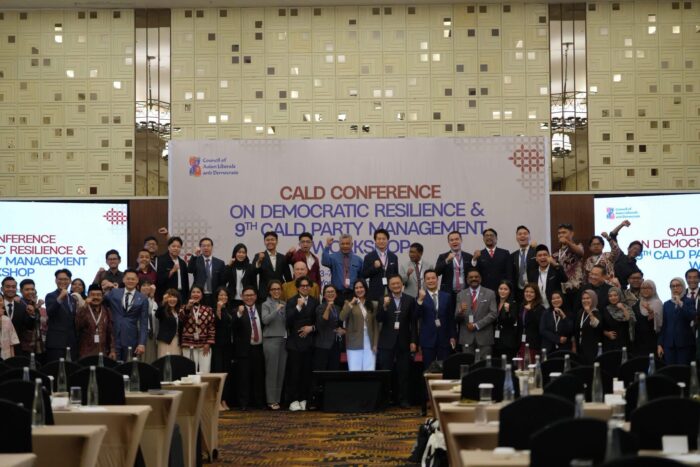
Strengthening Parties, Sustaining Democracy
The 9th CALD Party Management Workshop followed the conference on 5 September 2026, bringing together representatives from political parties and democratic movements across Asia to explore ways of strengthening party institutionalization across diverse political contexts. The workshop also provided a platform for CALD member-parties to exchange experiences and develop strategies for supporting one another in building stronger internal structures, democratic processes, and organizational capacity.
Participants discussed the use of legal and constitutional frameworks to constrain opposition, the challenges posed by external interference, and the need for political parties to adapt their strategies to their respective political contexts.
During the Fireside Chat, Ariffin Shah, an SDP youth member, highlighted the phenomenon of “authoritarian legalism,” through which governments can use the law to suppress opposition while maintaining the appearance of adherence to the rule of law.
Youth engagement emerged as another common priority. Speakers emphasized the need to make politics more relatable to younger generations, use innovative digital platforms, and address issues such as employment and mental health. Shah underscored the importance of making politics more attractive and relevant to young people.
Alysa Chiu, Deputy Director for International Affairs of the Democratic Progressive Party (DPP) of Taiwan, shared that younger voters are increasingly less attached to the traditional party identities and respond more strongly to everyday economic concerns and new forms of political communication.
Participants also highlighted creative fundraising, diaspora networks, international solidarity, and strong institutions as essential to sustaining democratic movements over the long term. “We are playing the long game,” said Samady Ou, Youth President of the Cambodia National Rescue Party (CNRP).
Building on the workshop’s focus on strengthening party institutions and preparing political organizations for the future, Mujab MS, a young cadre from PDI Perjuangan, shared his party’s experiences in strategic leadership, ideology, and institutionalization. He emphasized that “leadership provides direction, while institutions provide continuity,” underscoring the need to balance strong leadership with enduring party structures. He also highlighted five propositions for the next generation of political leaders: moving from ideological loyalty to ideological relevance; mass mobilization to meaningful participation; patronage to empowerment; political branding to institutional trust; and winning elections to strengthening democracy.
Across both the conference and workshop, participants emphasized that democratic resilience is ultimately a collective endeavor—requiring strong institutions, effective and democratic political parties, active citizens, and solidarity among those committed to defending democratic values.
The CALD Conference on Democratic Resilience in Southeast and East Asia and the 9th CALD Party Management Workshop were organized by the Council of Asian Liberals and Democrats (CALD) in cooperation with the Indonesian Democratic Party of Struggle (PDI Perjuangan).
Categorised in: News Article
This post was written by CALD
 Unit 409, 4/F La Fuerza Plaza 2, 2241 Don Chino Roces Ave. corner Sabio St., 1231 Makati City, Philippines
 +632 8819 60 71
 info@cald.org