


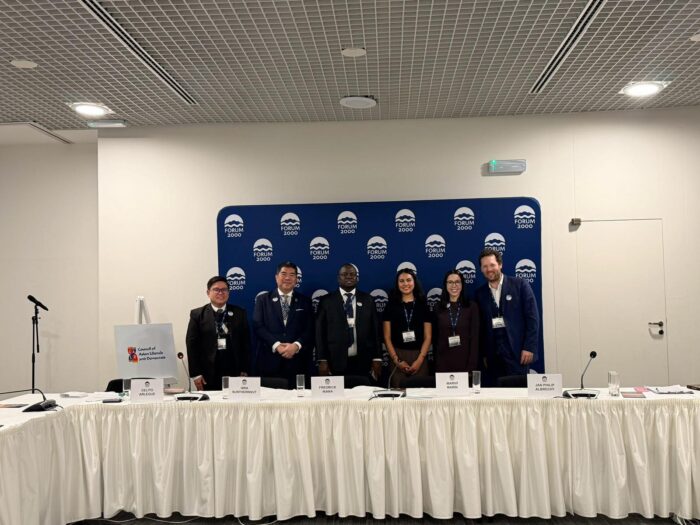
With over 800 participants, Forum 2000’s annual conferences are considered to be largest democracy gathering in Europe and one of the leading events of its kind in the world. For the 30th anniversary of Forum 2000 and the 90th anniversary of the birth of its founder, President Václav Havel, the Council of Asian Liberals and Democrats (CALD) was honored to be invited as one of the panel co-organizers.
Held on 11-13 October 2026 in Prague, Czech Republic, the milestone event carried the theme “Reimagining the Power of the Powerless”, which was a reference to one of the most influential ideas of Havel himself. This year’s guests included historian and Distinguished Research Fellow at the Centre for the Study of Existential Risk at the University of Cambridge Yuval Noah Harari; President of the Dominican Republic Luis Abinader; First Deputy Prime Minister and Minister of Foreign Affairs of Kosovo Glauk Konjufca; former President of Botswana Ian Khama; Stanford University professor and leading political scientist Larry Diamond; prominent Mozambican politician and Member of Parliament Ivone Soares; former President of Lithuania Dalia Grybauskaitė; His Beatitude Epiphanius, Metropolitan of Kyiv and All Ukraine; former President of Poland and Nobel Peace Prize laureate Lech Wałęsa; Minister of Foreign Affairs of Myanmar’s National Unity Government Zin Mar Aung; and Czech Minister of Health Adam Vojtěch. In an address by Miloš Vystrčil, President of the Senate of the Parliament of the Czech Republic, he reflected on Havel’s legacy: ”He reminds us that an authoritarian system rests not only on the power of the authoritarian leader but also on fear, indifference and resignation of people that do not believe that an individual can make a difference.”
During the opening night on 11 October, CALD co-organized a well-attended panel, “AI, Inequality and Democracy: The Challenge for Democratic Political Parties.” The panel recognized the need for policymakers, political party leaders and civil society members to work together in coming up with the right combination of policies and strategies to reduce AI-driven inequality, or to strengthen democracy and safeguard it against the fallout from increased disparities in income, wealth and power. The speakers included Thai Member of Parliament and Deputy Leader of the Democrat Party Isra Sunthornvut, President of Heinrich Boll Stiftung and Former Minister of Energy, Agriculture, the Environment, Nature and Digitalization, Schleswig-Holstein, Germany Jan Philipp Albrecht, Kenyan Member of Parliament Fredrick Ikana, and CEO of Probox Venezuela Maria Virginia Marin Vasquez. CALD Executive Director Lito Arlegue moderated the panel.
One of the most controversial issues that emerged from the discussions centered on the issue of AI regulation. Sunthornvut recognized that legislators are not as proactive on this issue because of capacity and also because of the concern that “the biggest killer of innovation is regulation.” Albrecht agreed that “there is good reason to be cautious” about AI regulation while also arguing for setting global standards on AI based on “human dignity and nondiscrimination.” Drawing from the experience of Kenya, Ikana also supported the need for “risk-based regulations” to cushion the economic impact of job displacement, particularly in developing countries. On the issue of regulation, Marin Vasquez asked an important question: “Who controls AI and for whose benefit?” She, however, also highlighted how AI could be used for good – such as the use of avatars to protect the identity of activists during the recent Venezuelan elections.
Apart from the panel, the CALD delegation was also invited to participate in “by-special invitation only” sessions like “Democratic Cooperation in the Indo-Pacific: Where Track 1.5 and Track 2 Can Add Value” and “Connecting Parliamentary Needs with Democratic Support Networks”. In the latter, Sunthornvut and Arlegue were joined by Member of Parliament from the Indonesian Democratic Party of Struggle (PDIP) Rio Dondokambey.
The final panel, “The Next 30: Power, Democracy and the Future of the Rules-Based Order”, Carl Gershman, Founding President of National Endowment for Democracy and Member of the Program Council of Forum 2000 Foundation, reflected on the main objective of the Foundation to build a community of people united in the belief that “human rights and freedom must become an integral part of any meaningful world order.” He then identified four dimensions of Havel’s thinking about this community: (1) it must empower people and give them hope as part of its strategy; (2) it must not give in to evil; (3) it must build democratic solidarity; and (4) it must be based on a transcendental/spiritual anchor.
The Forum 2000 was founded in 1996 as a joint initiative of the late Czech President Václav Havel, Japanese philanthropist Yohei Sasakawa, and Nobel Peace Prize Laureate Elie Wiesel. Since 1997, Forum 2000 organizes an annual conference which has attracted a number of prominent thought leaders, Nobel laureates, former and acting politicians, business leaders and other individuals, whose common denominative is experience with bearing responsibility.
Categorised in: News Article
This post was written by CALD
 Unit 409, 4/F La Fuerza Plaza 2, 2241 Don Chino Roces Ave. corner Sabio St., 1231 Makati City, Philippines
 +632 8819 60 71
 info@cald.org