



For the first time in its recent history, the Council of Asian Liberals and Democrats (CALD) formally met with the Institute for Democracy (ID), the principal policy think tank of South Korea’s Democratic Party of Korea (DPK), at the DPK Headquarters in Seoul on 22 June 2026. The meeting marked an important milestone in strengthening cooperation between two institutions committed to advancing liberal democracy, democratic resilience, and regional collaboration.
The CALD delegation was led by Chairperson Florencio “Butch” Abad and included Thai Member of Parliament Isra Sunthornvut, a member of CALD’s Strategic Communication and Fundraising Coordination Committee, and CALD Program Manager Paolo Zamora. Representing the Institute for Democracy were President Lee Jae-young, Director for Policy Research Kang Byung Ik, Director for External Cooperation Ko Young-kook, and Research Fellow Bae JeeYoung. Also present was Lim Sungeun of the Friedrich Naumann Foundation (FNF) Korea Office.
Opening the discussions, ID President Lee introduced the Institute’s work in supporting democratic governance through policy research and international cooperation. He highlighted the Institute’s longstanding partnership with the FNF, which has helped strengthen its policy capacity and international engagement.
Lee also recalled the Democratic Party of Korea’s long-standing engagement with CALD. Between 2011 and 2024, DPK leaders, legislators, and policy experts participated in five CALD international conferences, creating valuable opportunities for dialogue and democratic exchange across Asia.
“Our previous engagements with CALD have contributed to expanding democratic cooperation in the region,” Lee said. “We hope this meeting opens a new chapter of closer collaboration.”
The meeting focused on exploring concrete avenues for institutional cooperation while exchanging views on the evolving democratic landscape in Asia and recent political developments in South Korea.
Reflecting on Korea’s democratic journey, Lee underscored the importance of citizen participation in defending democratic institutions.
“We need to come up with integrated ways to move democracy forward and uphold its core values of freedom, human rights, and the rule of law,” he said.
He cited the Candlelight Revolution of 2016–2017 as a defining moment in Korea’s democratic history, when millions of citizens peacefully gathered in Seoul’s Gwanghwamun Square demanding accountability and ultimately contributing to the impeachment of President Park Geun-hye. Lee noted that Korea’s ability to overcome repeated democratic crises demonstrates how active citizen participation can strengthen democratic institutions.
“Korea’s democratic experience,” he added, “can serve as a useful reference for other countries in Asia seeking to deepen democratic governance.”
Lee also briefed the CALD delegation on the priorities of President Lee Jae-myung’s administration, which assumed office following the 2025 snap presidential election. According to Lee, the government is focusing on restoring livelihoods, revitalizing economic growth, expanding diplomatic engagement, and increasing Korea’s participation in regional affairs while improving the quality of life of Korean citizens during this period of transition.
He likewise expressed optimism that the Democratic Party of Korea’s strong performance in the 3 June 2026 local elections would contribute to more balanced regional development and strengthen local governance.
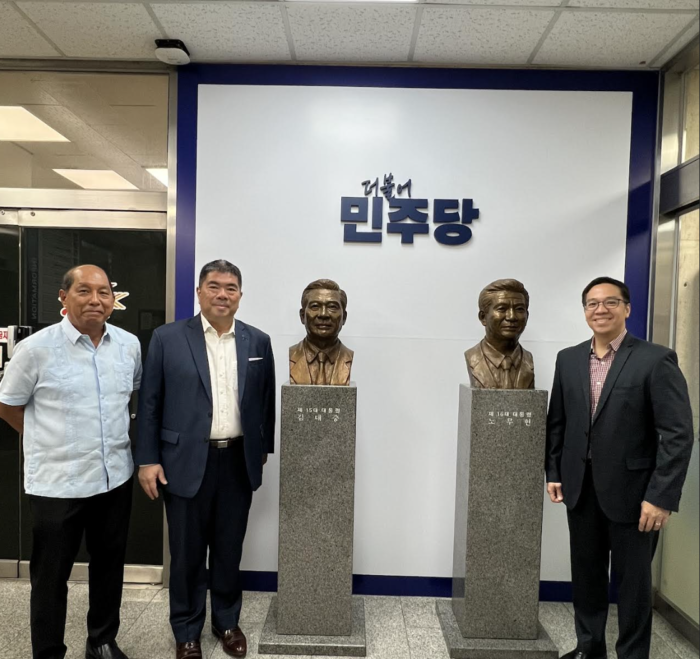
Responding on behalf of CALD, Chairperson Florencio Abad thanked the Institute for Democracy, the Democratic Party of Korea, and the Friedrich Naumann Foundation for organizing and facilitating the meeting.
He observed that many of the democratic challenges confronting Korea are also being experienced across Southeast Asia, particularly the rise of populism and authoritarian tendencies.
Abad provided an overview of CALD’s evolution from its founding into one of Asia’s leading networks of liberal and democratic political parties, serving as a platform for solidarity, democratic dialogue, and policy exchange.
He stressed that democratic institutions become stronger when political parties are supported by capable policy institutes and think tanks that can generate evidence-based policies and strengthen democratic advocacy.
“The continuing exchange and cooperation between CALD and the Institute for Democracy can help build a stronger regional foundation for democracy,” Abad said. “While authoritarianism continues to shape politics in many parts of Southeast Asia, partnerships such as this allow us to learn from one another and strengthen democratic institutions together.”
Thai Member of Parliament Isra Sunthornvut shared Thailand’s own democratic experience, describing it as a continuous journey marked by progress and setbacks.
“In Thailand, we have experienced many ups and downs,” he said. “People often feel our democracy is imperfect, but no democracy is ever perfect.”
He argued that the true measure of democracy lies not simply in constitutional design but in the existence of spaces where dissenting voices can be heard.
“I consider Korea, the Philippines, and Thailand genuine democracies not because their systems are flawless, but because they provide space for opposing views. That, to me, is the true test of democracy.”
Sunthornvut also emphasized CALD’s importance as a trusted regional platform where democratic leaders can exchange ideas openly.
“CALD provides a safe space for like-minded politicians to discuss ideas freely—conversations that, at times, are difficult to have in our own countries.”
The meeting concluded with both institutions expressing their commitment to deepen cooperation through future exchanges, policy dialogues, and joint activities. CALD also invited the Institute for Democracy and the Democratic Party of Korea to participate in the 9th CALD Political Party Management Workshop, to be held in Yogyakarta, Indonesia, from 27–31 August 2026.
In closing the meeting, Lee reaffirmed the Institute’s commitment to working closely with CALD and its partners. “Democracy is not something that can be achieved by one country alone. It is a universal value that we must work for together,” Lee said. “I hope this meeting marks the beginning of greater efforts to promote democracy, prosperity, and peace throughout our region.”
He concluded by renewing the Institute’s commitment to continued collaboration. “We at the Institute for Democracy reaffirm our commitment to strengthening cooperation with CALD and the Friedrich Naumann Foundation so that together we can advance democracy, inclusiveness, and democratic resilience across Asia.”
Categorised in: Uncategorized
This post was written by CALD
 Unit 409, 4/F La Fuerza Plaza 2, 2241 Don Chino Roces Ave. corner Sabio St., 1231 Makati City, Philippines
 +632 8819 60 71
 info@cald.org