


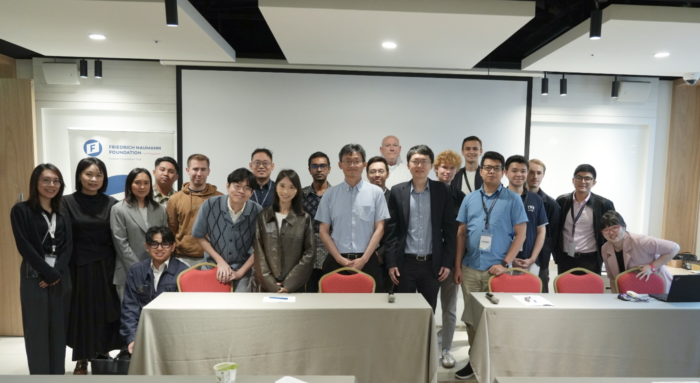
Youth delegates from the Council of Asian Liberals and Democrats (CALD) and Junge Liberale (JuLis), the youth wing of Germany’s Free Democratic Party (FDP), gathered in Taiwan for the three-day CALD Youth Political Academy (CYPA), organized by CALD Youth and the Friedrich Naumann Foundation (FNF) – Taiwan Office.
CYPA 2026 brought together young political leaders to engage in dialogue, exchange perspectives, and participate in discussions on democratic values and civic engagement. It was shaped to provide deeper insight into Taiwan’s political environment while exploring how geopolitical, technological, and societal factors intersect in shaping resilience. It was also a space for participants to collaborate on policy ideas and outputs relevant to liberal youth movements.
Taiwan’s government, supported by its democratic institutions, has driven strong economic growth in recent decades. This has established it as a high-income economy and a global leader in semiconductors, supported by a strong industrial base and ongoing investment in innovation. Local councilors also reflect these democratic principles through close community representation and responsive governance.
During a fireside chat with delegates, Taipei City Councilor Sabrina Lim drew from her experience as a public servant to emphasize the importance of building trust with stakeholders.
“Building trust between you and voters should always be seen as the first step,” Lim said, noting that this is key to ensuring citizens are genuinely willing to listen to or support one’s advocacies. This inspired participants to reflect whether liberals found the right start point when promoting liberalism around the world.
Meng-hua Ho, another featured panelist and city councilor, shared her experience of addressing concerns related to the People’s Republic of China’s (PRC) influence in Taipei City, which resonated with many participants and served as a reminder that liberals should remain mindful of the growing influence of external authoritarian forces in local politics.
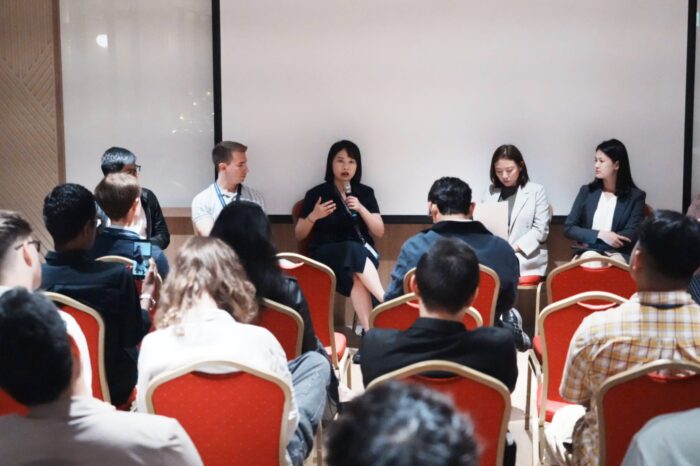
CALD Youth Chairperson and Taiwan’s Democratic Progressive Party (DPP) Deputy Director Michelle Wu reflected on her journey from civil society activism to political engagement, highlighting the role of youth-led initiatives in shaping Taiwan’s democratic landscape.
She further explained that despite holding the top national post for three consecutive terms, the party seeks to remain responsive to the evolving needs of Taiwanese society, especially the youth.
“Taiwan is an independent, sovereign country. We are also a very responsible party that can ensure the strong performance of Taiwan’s economy,” she said, highlighting Taiwan’s 13.69% GDP growth in the first quarter of 2026 — the highest in 39 years — as evidence of the party’s performance.
Calvin Nixon, International Officer for Junge Liberale, weighed in on German perspectives on liberal values and how they align with those in Taiwan. Meanwhile, Jeremiah Tomas, former CALD Youth Chairperson, shared his reflections on liberal values, noting gradual shifts in public sentiment and highlighting the importance of thoughtful leadership in the years ahead.
“You see everything that’s happening in the world, and you don’t know what’s going to happen in the next six months, a year, five years from now because things have started to unravel,” Tomas said.
Delegates also visited several sites of cultural and political significance in Taiwan, including the Nylon Cheng Liberty Museum. The museum honors freedom of expression advocate Cheng Nan-jung, who became a symbol of press freedom following his self-immolation in protest against political repression. His daughter, Cheng Chu-mei, continues to preserve his legacy.
Participants later engaged in a learning session on civil society responses to external threats, gaining insights into how various organizations — including schools and universities — can contribute to civil safety and national resilience. The session was facilitated by Kuma Academy chair Wen Liu, together with scholars Yu-rung Chyn of the Awakening Foundation and Mei-chun Lee of the Cyborg Resilience Co-Lab.
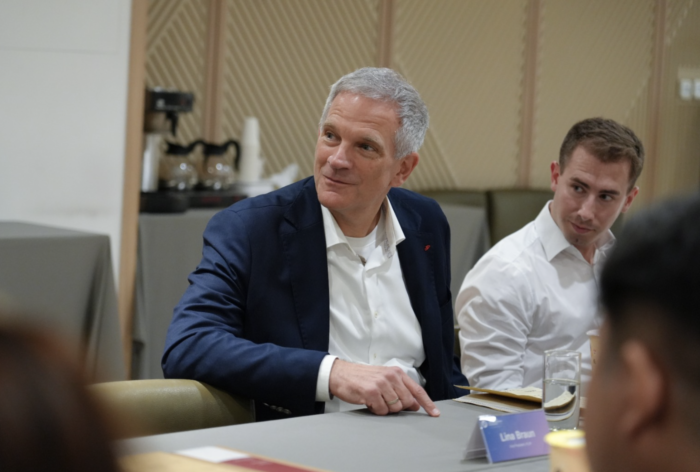
As the CYPA neared its conclusion, delegates were given the opportunity to meet with the Director General of the German Institute Taipei, Karsten Tietz, who delivered a short talk on German-Taiwan relations and offered a European perspective on Indo-Pacific relations between Germany and Taiwan. The face-to-face engagement was warmly received by participants.
CALD Youth Chairperson Michelle Wu highlighted the significance of the CYPA program, saying she hoped it would inspire delegates to apply the lessons from the exchange in their future work, viewing democracy as a shared responsibility and strengthening political engagement.
“Through CYPA, young leaders from Asia and Germany explored Indo-Pacific security through Taiwan’s democratic journey,” Wu said. “I hope this experience inspires us to see democracy as both a lived commitment and a shared responsibility across borders.”
As the program concluded, delegates left with a renewed sense of purpose and motivation to carry their experiences into their respective fields.
Categorised in: News Article
This post was written by CALD
 Unit 409, 4/F La Fuerza Plaza 2, 2241 Don Chino Roces Ave. corner Sabio St., 1231 Makati City, Philippines
 +632 8819 60 71
 info@cald.org