


Is Asia democratically resilient?
It appears that there is no easy answer to this question given the varying levels of democratic development in the region. It has to be said, however, that democratic resilience — defined as the ability to withstand, adjust, recover, or “bounce back” to a pre-existing state of normality after a shock — remains to be an aspiration for many Asian countries to this day.
Given this reality, the Council of Asian Liberals and Democrats (CALD) pushed for stronger and more resilient democracy in 2025, amidst the challenges and opportunities brought about by rapid technological changes. As described by CALD Secretary General Francis “Blue” Abaya. “…Across Asia and beyond, CALD stood shoulder to shoulder with fellow liberals and democrats as a trusted partner and unwavering ally in the fight for freedom, democratic resilience, and human dignity.”
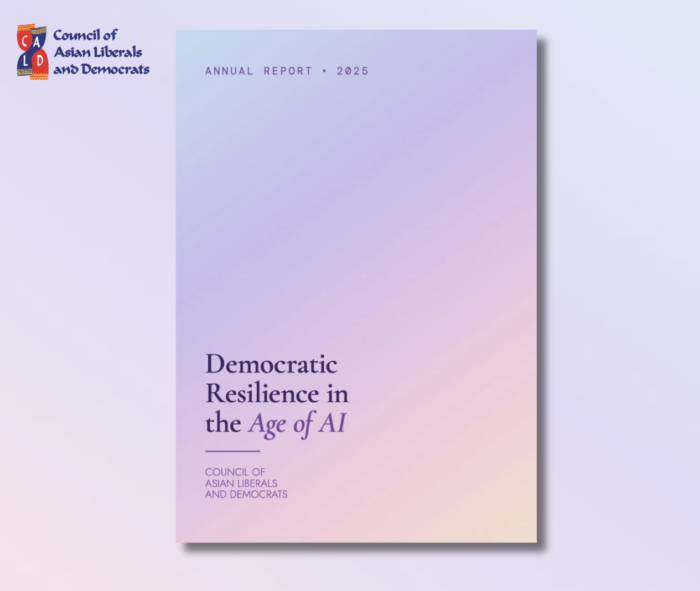
This commitment to democratic resilience inspired the title of CALD’s 2025 Annual Report, Democratic Resilience in the Age of AI. The title reflects not only the organization’s values, but also the major themes explored throughout CALD’s activities over the past year and for this year, as well.
Throughout 2025, CALD organized multiple events promoting democratic resilience while examining the growing impact of artificial intelligence.
Among these was the CALD Regional Conference on South China Sea Disputes Under Trump 2.0, which tackled rising incidents in disputed waters, their implications for regional security, and the urgent need for coordinated, rules-based responses among claimant states. CALD also convened a Roundtable Discussion on the 2025 Philippine Elections in Manila, which unpacked critical issues shaping the country’s political landscape. CALD Women’s Caucus also held its Strategic Planning Meeting and the Asian Women Education Mentorship Program, which brought together emerging women leaders for a three-month journey of leadership development, sisterhood, and cross-border collaboration.
Meanwhile, the CALD Youth Political Academy 2025 in Taipei focused on empowering young leaders to defend democracy while harnessing technology for positive change. The report also highlights the 15th CALD General Assembly and 51st CALD Executive Committee Meeting held in Bangkok under the theme “AI, Inequality and Democracy: The Challenge for Liberals and Democrats.” The gathering examined how artificial intelligence is reshaping economies and political systems with the potential either to deepen inequality and erode democratic trust, or to enhance participation and institutional efficiency.
In addition, the report revisits the Liberal International (LI) Congress held in Manila in 2011. This featured article is especially timely as LI, with the support of CALD, prepares to hold its congress in Asia once again this 2026.
The publication also features speeches from prominent democratic leaders and advocates. Former Philippine Vice President Leni Robredo emphasized the importance of keeping artificial intelligence human-centered in her keynote address during the opening session of the 15th CALD General Assembly: “AI is here to stay, for better or for worse. There is no more putting the genie back into the bottle.”
Together with Mamamayang Liberal Party-List Representative Leila de Lima’s “The Importance of Accountability”, 2022 Nobel Peace Prize Laureate Oleksandra Matviichuk’s “Why We Fight”, Former CALD Chairperson and Cambodia Senator Mardi Seng “A Border of Cooperation, Not Conflict”, and Democrat Party Leader and former Thai Prime Minister Abhisit Vejjajiva’s “Having Faith in People”.
Vejjajiva warned that if AI creates a culture where people are only interested in results and does not care about the means and the process, democracy will ultimately be at risk. However, he also underscored the enduring liberal democratic belief in people: “…For all the risks that we fear, we have to also remember that as liberals and democrats, our basic tendency is we have faith in people. If we provide them with the opportunities, with the literacy of how we use AI, we must also trust them to be able to use and come up with systems of governance to ensure that AI does really work for all of us humans.”
In his final message as CALD Chairperson, Senator Seng reflected on the organization’s progress with gratitude and optimism, “While much work remains to be done, I hope that CALD today has a much stronger foundation and a clearer path toward the goals ahead. As I look toward the new leadership, I do so with a heart full of gratitude and a firm belief that the heights we have reached together are only the beginning.”
As Asia confronts the intertwined challenges of artificial intelligence, inequality, and democratic backsliding, CALD moves forward with renewed purpose and determination.
We invite you to look back on CALD’s 2025 journey through this report and join us in continuing the work of strengthening democratic resilience across Asia and beyond.
Categorised in: News Article
This post was written by CALD
 Unit 409, 4/F La Fuerza Plaza 2, 2241 Don Chino Roces Ave. corner Sabio St., 1231 Makati City, Philippines
 +632 8819 60 71
 info@cald.org