


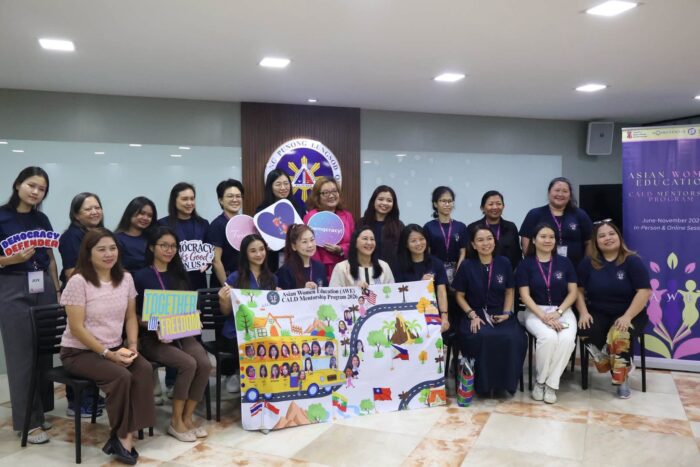
“What does feminist leadership look like when applied to real political work and lived leadership contexts?”
This question formed the heart of Chapter 2 of the Asian Women Education (AWE) Mentorship Program 2026 as the group from across Southeast and East Asia gathered in Rizal & Quezon City, Philippines, from 10 to 14 September for a four-day Community Exposure. Moving from the foundational work of identity, values, and feminist analysis established during the Bangkok launch and two online regional sessions, the Community Exposure invited mentees to witness Transformative Feminist Leadership (TFL) in real-world settings.
Organized by the Women’s Caucus of the Council of Asian Liberals and Democrats (CALD), the AWE Mentorship Program seeks to cultivate women leaders grounded in liberal democratic values and equipped to meaningfully participate in political and public leadership. At its core is TFL, a practice that challenges unequal power, builds collective agency, and enables women to contribute to more inclusive and democratic ways of shaping decisions and society. Chapter 2, aptly titled “TFL in Action,” brought this vision into practice by placing the mentees in direct conversation with women leaders from local government, civil society, and political movements.
The journey began on the evening of 10 September with a Welcome Dinner in Quezon City, where the cohort was formally welcomed by AWE mentors and local partners. The evening featured welcome remarks from Atty. Cyrille “Beng” Abueg-Zaldivar, Head of the Women’s Caucus of the Liberal Party of the Philippines (LP); Jaslyn Go, Chairperson of the CALD Women’s Caucus; and Dr. Almut Besold, Country Director of FNF Philippines, followed by a solidarity message from Rep. Leila de Lima of Mamamayang Liberal, delivered by CALD Women’s Caucus Vice Chairperson Alysa Chiu. In her message, Rep. de Lima encouraged the mentees to recognize the victory of women gaining entry into spaces of power, while also reminding them that their presence must be used to shape decisions and create pathways for those who follow: “It is not enough for us to reach positions of influence. What matters is what we do once we are there, whom we bring with us, and whose interests we choose to defend.” Recognizing that the AWE cohort comes from different societies, political traditions, and lived experiences, she further emphasized: “Democracy does not require sameness. It asks us to listen seriously, to disagree without diminishing one another, to learn across our differences, and to recognize the moments when our shared commitment to dignity, freedom, and democratic life requires us to stand together.”
The evening eventually transformed into a celebration of “Sisterhood Across Borders,” the program theme, giving mentees, mentors, partners, guests, and AWE fellows the opportunity to reconnect, exchange stories, and strengthen the regional bonds at the heart of the AWE community.
The following morning, the mentees moved from the dinner table into the field, spending the whole day learning from the local government of Quezon City. A key moment that kicked off the day was a mentoring session with the City Mayor Josefina “Joy” Belmonte, which gave the mentees the opportunity to reflect on what it means to lead a city through a feminist lens. Mayor Joy began by sharing her own journey. Although she came from a political family, her background was not originally in politics. A passionate archaeologist, she spoke about her desire to understand Filipino identity by uncovering the cultures of early communities and learning how people lived, before reflecting on how her path eventually led her into politics. From there, she shared how she navigated differing opinions from family, partners, and communities, learned from practices across neighboring countries, and gradually found her own footing as a leader. She also shared her current programs and initiatives, connecting them to the political realities and experiences of the mentees in their respective countries. When asked how she hopes to be remembered in history, she said it would be for what her administration made possible, shifting the core of leadership back to the community: “It should never be about me or my leadership. It should always be about them (community), and what they think or what they experienced during my term,” she emphasized. As she reflected, she expressed her hope that people would remember a time when many of these possibilities seemed out of reach, but Quezon City showed that they could be made possible. This mentoring hour was followed by a short presentation by Janete Oviedo, Head of the city’s Gender and Development Council Office, preparing the group for their community visit to the programs and institutions serving women and marginalized communities. The learning visit included the Quezon City Protection Center (QCPC), Milk Bank, Jail Female Dormitory, and the Tandang Sora Women’s Museum. Rather than simply observing these programs, the mentees were encouraged to listen, ask questions, and understand how gender-responsive governance takes shape in the everyday realities of communities.
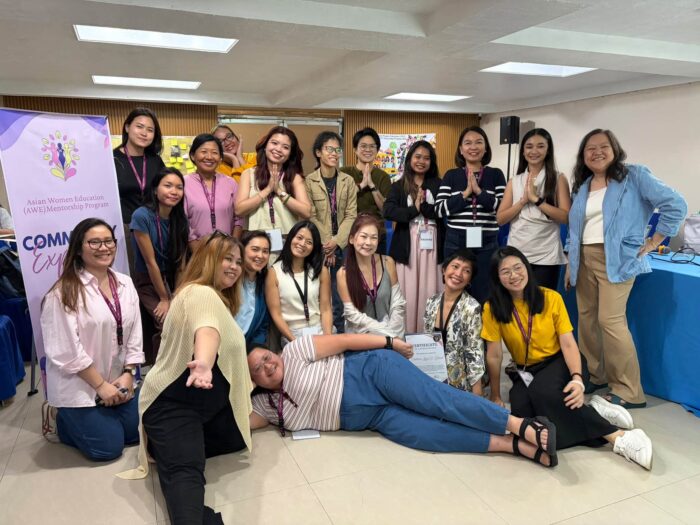
Together, these encounters demonstrated that feminist leadership is not confined to a particular position or institution. Rather, it is practiced through policy, community programs, public service, advocacy, and the everyday work of responding to people’s needs.
On 12 September, the cohort gathered at the Diliman Campus of the University of the Philippines for a day centered on reflection, bodily autonomy, gender analysis, and storytelling. The morning began with a debriefing session, giving mentees space to process what they had seen, heard, and felt during their community exposure. The conversation then turned inward during “Power, Pleasure, and Boundaries” session facilitated by Prof. Sabrina Gacad of Lunas Collective, where she examined the intersection of power, pleasure, bodily autonomy, and political leadership, positioning sexual and reproductive health and rights as a political concern while emphasizing boundary-setting as an essential leadership practice. It also invited participants to examine conventional assumptions and other internalized limitations that can constrain women’s political imagination and power.
From there, the mentees moved from personal reflection to analytical analysis through the session “Gender Analysis Tools: Intersectionality & Social Relations Approach,” led by Prof. Gaynor Tanyang of Lumina Ventures. Both mentees and mentors first reflected on how personal characteristics, including age, class, ethnicity, and disability, can facilitate or hinder access to leadership and opportunities, while recognizing how these factors can intersect with gender to shape experiences of inclusion and exclusion. The discussion then shifted to the institutional level through the Social Relations Approach, examining how rules, people, resources, and activities shape the distribution of power and opportunities within institutions. The mentees were further encouraged to consider what laws, policies, and programs enable or hinder women from occupying leadership positions in their organizations and countries, and how transforming social relations requires examining and redistributing power. Care work was likewise examined as a structural issue that can, and should be understood in political and policy terms.
The afternoon brought the personal and the collective together through Feminist Storytelling Weaving, facilitated by Prof. Tez D. Cruz of the Feminist Media Lab. Building on the individual leadership stories highlighted during the second online regional session in August, the mentees reflected on how they each entered AWE with their own histories, aspirations, and leadership journeys, and how these paths converged through the shared experience of the mentorship program. Through collaborative storytelling and photography activities, they explored what their collective story has become, and which images, voices, and silences can capture this shared chapter of their journey. The process also looked ahead to the paths that will diverge again as they complete AWE and return to their respective communities and leadership spaces, carrying with them the connections, lessons, and experiences they have gained together. These stories and reflections will form part of a photo book documenting their journey as an AWE cohort.
These sessions equipped the mentees with the analytical tools and political grounding to move from understanding power to practicing influence. On the final day, they were challenged to translate these frameworks into the work of advocating, engaging decision-makers, holding political positions, and mobilizing others toward action. This was explored through a practical session facilitated by Chiu, also a program mentor and a representative of Taiwan’s Democratic Progressive Party (DPP), who guided the mentees through simulations involving a feminist advocate, a local legislator, a businesswoman, and an undecided group. By navigating competing interests and perspectives, the mentees experienced the practical realities of making an argument, building support, and advancing an issue in contested political spaces. The session thus bridged the personal and analytical work of the preceding days with the explicitly political work that followed, moving the cohort from individual advocacy toward collective power-building. It bridges the analytical work of the preceding sessions and the panel that followed, where women leaders from different sectors and lived experiences shared how they navigate political and public spaces and exercise influence from where they stand.
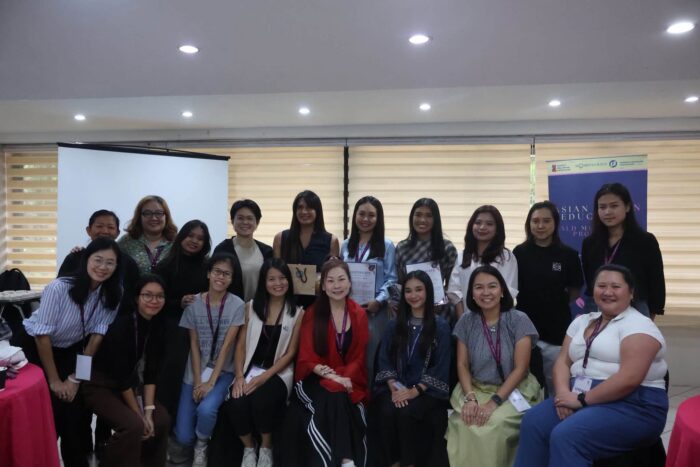
The morning closed with a panel discussion on “Building Collective Power: Movements, Campaigns, and Networks,” moderated by program mentor Senator Yashinta Sekarwangi of Indonesia’s Democratic Party of Struggle (PDIP). Featuring members of LP: Asec. Marjorie Martin Chan from the Office of the Presidential Adviser on Peace, Councilor Jom Bagulaya from Tacloban, and Councilor Ivy Nicole Cuadro of the Sangguniang Kabataan Municipal Federation (SKMF) in Candelaria, Quezon, the panel brought together distinct pathways to political influence – from organizing around women and peacebuilding, to building grassroots power through intersectional identities, to mobilizing young people through formal political and governance structures. Rather than treating organizing, campaigning, and networking as separate activities, the discussion showed how they can function as interconnected forms of political infrastructure: building constituencies, sustaining movements, translating collective energy into political outcomes, and creating relationships across sectors, parties, and civic organizations. The panelists also shared how they navigate discrimination against women in politics, maintain their integrity as public officials, and work within different institutional and political spaces as Chan reflected, “I think as leaders, that’s the last thing we should really give up, our integrity, because if we do give up our integrity, then everything will go down the drain. And for us to keep that, we have to be able to hold on to that core.” For the mentees, the discussion provided practical examples of how collective power is built and sustained, while inviting them to identify the networks, constituencies, and organizing practices they can carry into their own contexts. In doing so, the panel reinforced a central lesson of Chapter 2: individual leadership becomes more powerful when it is connected to collective action, relationships, and a wider political ecosystem.
The four-day exposure concluded with a Closing Circle, where the group gathered to reflect on what the experience meant to them and what they would carry forward into the months leading to Chapter 3. After days of moving between community spaces, government institutions, classrooms, storytelling circles, and conversations with women leaders, the closing session offered a moment to pause and make meaning of the journey. Through intertwining yarns, the cohort shared what they can contribute to strengthening the sisterhood in the months to come.
The AWE Community Exposure is an opportunity for the cohort to see transformative feminist leadership in practice – in the work of local governments, in the realities of communities, in conversations about bodies and boundaries, in the stories women tell about their political journeys, and in the collective power built through movements and networks.
As the group left Quezon City and prepared to continue their mentorship journey, having one more online regional session before its culmination in November, they carried with them a deeper understanding of what it means to lead with others. From knowing self, to leading with others, and ultimately to shaping the future, AWE continues to ask women not simply to find a place within existing systems, but to imagine and participate in building the democratic futures they want to see.
The AWE Mentorship Community Exposure was held with the support of Friedrich Naumann Foundation for Freedom Asia (FNF) and Taiwan Foundation for Democracy (TFD).
Categorised in: News Article
This post was written by CALD
 Unit 409, 4/F La Fuerza Plaza 2, 2241 Don Chino Roces Ave. corner Sabio St., 1231 Makati City, Philippines
 +632 8819 60 71
 info@cald.org