


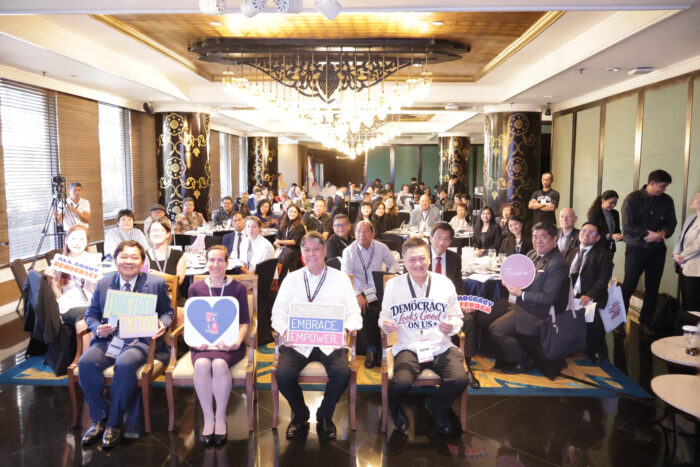
In a regional policy roundtable held in Manila, Philippine Senator Francis “Kiko” Pangilinan underscored the urgency of defending democratic systems among Asian counterparts while also acknowledging the realities faced by ordinary citizens.
“We must also remember something that is easy to forget in times of hunger and fear: Democracy is not rice. It will not fill an empty stomach. When people say, ‘we cannot eat democracy’, they are not wrong.” However, democracy remains fundamental to our society. “…democracy does something just as essential for a fully human life. It feeds the psyche and nourishes the spirit. It gives each person the sense that they are not simply an object of decisions, but a subject in history—a maker of decisions, a bearer of dignity, a participant in shared history,” he added.
Pangilinan also highlighted that strengthening democratic resilience requires more than institutional reforms. “…democratic resilience is not just a list of institutional fixes agreed upon in halls like this. It is also a cultural and relational project. It is about rebuilding trust and meaningful connections between leaders and led. It is about renewing the social contract so that people feel democracy in their daily lives as protection, as dignity, as voice.”

The roundtable was organized by the Council of Asian Liberals and Democrats (CALD), a regional network of liberal and democratic political parties in Asia, focusing on democratic resilience in Southeast and East Asia. Held on 27 March 2026 at Dusit Thani Manila, the roundtable gathered political leaders, policymakers, academics, media practitioners, and civil society members from across Asia and partner regions to examine the challenges facing democracies and to develop policy recommendations to strengthen democratic resilience. During the event, it was emphasized that democratic resilience is not only about institutional safeguarding but also about maintaining public trust, participation, and accountability.
The roundtable featured two panel discussions, composed of political party, media and civil society leaders: (1) Analyzing Democratic Resilience: Sources and Challenges, chaired by Samady Ou (Cambodia), with speakers Alysa Chiu (Taiwan), Isra Sunthornvut (Thailand), Lee Boon Shian (Malaysia), and James Gomez (Thailand/Singapore), bringing together political leaders, party representatives, and policy researchers to share country and regional perspectives on democratic trends; and (2) Enhancing Democratic Resilience: Institutions, Policies and Practices, chaired by Marites Vitug (Philippines), with panelists Leena Rikkilä Tamang (Australia, online), Hasto Kristiyanto (Indonesia), Florencio “Butch” Abad (Philippines), and Chee Soon Juan (Singapore).
It also featured a special message from Jose Ramos-Horta, President of the Democratic Republic of Timor-Leste, 1996 Nobel Peace Prize Laureate, and Honorary CALD Individual Member, who offered a message of optimism amid global concerns on democratic decline.
“The pessimistic views are that democracy is in regression, a setback worldwide. My view is that these are temporary phenomena… There is no real cause to say democracy is in retreat. What we need to do is continue to adhere to the values of liberal democracy: fundamental human rights and freedoms, freedom of the press, freedom of political organization and expression, tolerance of political pluralism, and respect for all religions.”
CALD calls on all to stand firm in defending and advancing resilient democracy across Asia and beyond.
Categorised in: News Article
This post was written by CALD
 Unit 409, 4/F La Fuerza Plaza 2, 2241 Don Chino Roces Ave. corner Sabio St., 1231 Makati City, Philippines
 +632 8819 60 71
 info@cald.org