


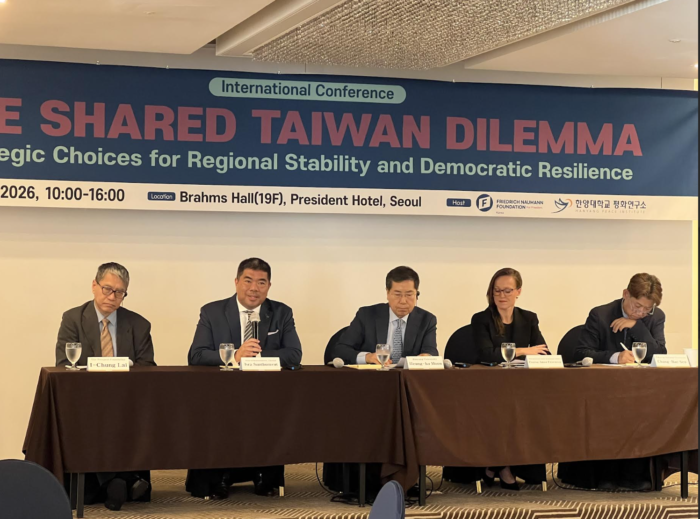
On 23 June 2026, delegates from the Council of Asian Liberals and Democrats (CALD) joined policymakers, scholars, civil society leaders, and students at the international conference “The Shared Taiwan Dilemma: Strategic Choices for Regional Stability and Democratic Resilience” in Seoul, South Korea. Co-organized by the Friedrich Naumann Foundation (FNF) Korea and the Peace Institute of Hanyang University, the conference convened participants from South Korea, Southeast Asia, and Europe to examine practical strategies for reducing the risk of conflict across the Taiwan Strait while strengthening economic resilience and democratic institutions amid growing geopolitical uncertainty.
Representing CALD were Chairperson Florencio “Butch” Abad, former Philippine Secretary of Budget and Management; Thai Member of Parliament and Democrat Party Deputy Leader Isra Sunthornvut; and Andi Widjajanto, Head of the Research Agency of the Indonesian Democratic Party of Struggle and former Cabinet Secretary of Indonesia. They were joined by I-Chung Lai, President of Taiwan’s Prospect Foundation; Sungeun Lim of FNF Korea; and CALD Program Manager Paolo Zamora.
In his opening remarks, Dr. Hong Yong-pyo, Director of the Peace Institute at Hanyang University and former Minister of Unification of the Republic of Korea, described developments in the Taiwan Strait as “a global challenge” and a complex dilemma with implications far beyond the region. As democratic and authoritarian systems increasingly compete, he warned that institutions face mounting pressure. Stressing that “there is no one-country solution,” Hong expressed hope that the conference would serve as a bridge for deeper understanding and generate valuable insights that contribute to regional peace.
The first session, “Preventing Escalation and Safeguarding Regional Security,” explored diplomatic pathways and confidence-building measures aimed at reducing miscalculation, strengthening trust, and preserving a stable, rules-based regional order.
Dr. Ho-ryong Lee, Senior Research Fellow at the Korea Institute for Defense Analyses (KIDA), argued that tensions in the Taiwan Strait have evolved from a cross-strait issue into a broader regional security challenge with significant consequences for global economic stability and South Korea’s national security. He maintained that “the realistic solution is to prioritize confidence-building measures by making crisis communication channels operational and reviving cross-strait dialogue,” while emphasizing that middle powers such as South Korea can play a constructive role in facilitating dialogue and preventing conflict.
Offering Indonesia’s perspective, Widjajanto said the country’s response should remain anchored in its long-standing foreign policy principles of Bebas-Aktif (independent and active diplomacy), the Bandung Spirit, and Marhaenism, which prioritize peace, sovereignty, and the welfare of ordinary people over great-power rivalry. Echoing Mohammad Hatta’s vision of “rowing between two reefs,” he declared, “We will not be enlisted. But we will not look away.”
He proposed practical confidence-building measures, including crisis hotlines, protocols for gray-zone activities, party-to-party communication, and safeguards for economic interdependence. The immediate goal, he noted, is not to resolve the dispute outright but to “keep it on the reversible side of the line” and preserve conditions for a peaceful future.
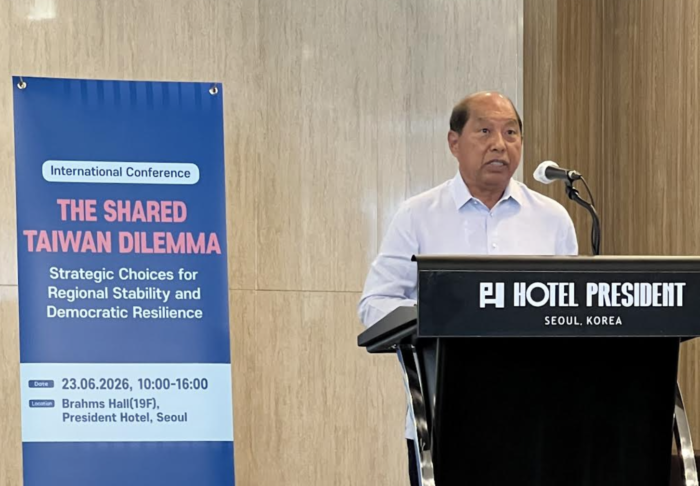
Abad emphasized that instability in the Taiwan Strait would have profound consequences for the Philippines and the wider Indo-Pacific, making it “not just Taiwan’s problem” but a shared regional security concern. Drawing on the Philippines’ strategic geography, particularly the proximity of his hometown of Batanes to Taiwan, he cautioned that “the greatest danger facing Asia” is “not war by design, but war by miscalculation,” as increased military activity heightens the risk of unintended conflict.
He underscored that effective deterrence must be accompanied by diplomacy through crisis communication mechanisms, agreed rules governing maritime and air encounters, humanitarian contingency planning, and sustained political dialogue. “The objective,” Abad said, “is not to eliminate competition, but to prevent competition from becoming a conflict,” stressing that regional peace, democratic resilience, international law, and global supply chains all depend on stability across the Taiwan Strait.
The second session, “Economic and Democratic Resilience under Pressure,” examined how governments can strengthen critical industries, reinforce democratic governance, and enhance economic resilience amid intensifying geopolitical competition.
Dr. I-Chung Lai argued that a Taiwan contingency would rapidly become a global contingency, disrupting international trade, semiconductor production, and the economies of South Korea and Southeast Asia. He warned that the conflict is no longer hypothetical, asserting that “the conflict has already begun” through military pressure, cyberattacks, and gray-zone coercion.
Framing the issue as an ideological struggle, Lai remarked that “this is not a war over independence, but a war by China on democracy,” emphasizing that any crisis would reverberate across global commerce, artificial intelligence, semiconductor production, and the rules-based international order.
Providing a European perspective, Dr. Zsuzsa Anna Ferenczy, Visiting Fellow at the Wilfried Martens Centre for European Studies and Adjunct Professor at National Dong Hwa University in Taiwan, observed that Europe has entered a new strategic era in which resilience, economic security, and geopolitical competition are increasingly interconnected. She explained that Europe faces a more fragmented international environment characterized by strategic dependencies and stated that “Europe is stepping up to build resilience” in response to a less engaged United States, an aggressive Russia, and an increasingly assertive China. She highlighted trusted partnerships among the European Union, Taiwan, ASEAN, and other Indo-Pacific partners as essential to strengthening regional cooperation.
From Southeast Asia, Sunthornvut argued that economic security and democratic resilience are inseparable, warning that disruptions to critical supply chains can directly undermine national sovereignty and democratic governance. He noted that simultaneous crises in major maritime chokepoints—including the Strait of Hormuz, the Red Sea, and the Taiwan Strait—could trigger severe global economic and industrial shocks. Pointing to Thailand’s National Semiconductor Roadmap as a practical example of resilience-building, he urged ASEAN to prioritize direct bilateral dialogue in resolving regional disputes while reducing dependence on external powers. “Economic vulnerability is the backdoor to democratic erosion,” he said, adding that “maritime choke points do not just carry physical commodities; they anchor systemic stability.” He further argued that “ASEAN must become an independent global superpower” through deeper economic integration, coordinated supply chains, collective energy security, and stronger digital defense cooperation.
Concluding the conference, Professor Seo Chang-Bae of Pukyong National University explained that intensifying U.S.-China competition has transformed global supply chains into a central arena of geopolitical rivalry, particularly in semiconductors, artificial intelligence, and critical minerals. Describing the current international environment as the “Era of Great Transformation/Transition,” he observed that geopolitical and economic competition have become increasingly intertwined. Although he assessed that “China’s direct invasion of Taiwan is considered unlikely,” Seo warned that continued uncertainty across the Taiwan Strait could still produce severe disruptions to global trade and industrial production.
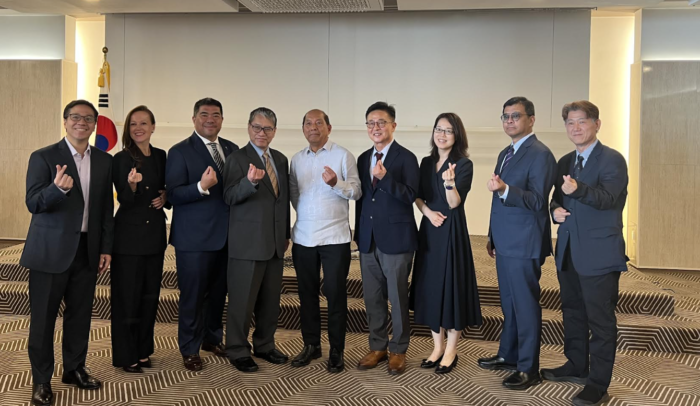
Bringing together perspectives from East Asia, Southeast Asia, and Europe, the conference underscored the value of sustained dialogue in addressing one of the region’s most pressing strategic challenges. While participants offered diverse national perspectives, they shared a common conviction that continued cooperation, confidence-building, and democratic resilience remain essential to preserving peace and stability in the Indo-Pacific.
Categorised in: News Article
This post was written by CALD
 Unit 409, 4/F La Fuerza Plaza 2, 2241 Don Chino Roces Ave. corner Sabio St., 1231 Makati City, Philippines
 +632 8819 60 71
 info@cald.org